
H1-H6 Headings - How to Use Them on a Website for SEO
Chaotically placed headings on your website rarely lower rankings directly, but they make it harder for Google bots and users to understand what a subpage is about. H1-H6 headings are HTML tags that organize content into a pyramid-like structure: from the main H1 title, through subordinate H2 and H3, down to detailed H4-H6. A proper heading structure is not a matter of aesthetics, but of logic: it helps users understand the content, makes scanning easier, and supports website visibility and accessibility.
Optimizing headings for SEO involves the deliberate placement of keywords in H1-H6 tags to signal to search engines which parts of the content are most important. Below, we show step by step how to build a heading hierarchy on a page when creating headings, what to avoid, and how to verify the results - without perpetuating the myths that have grown around this topic.
What HTML headings are and how they are structured
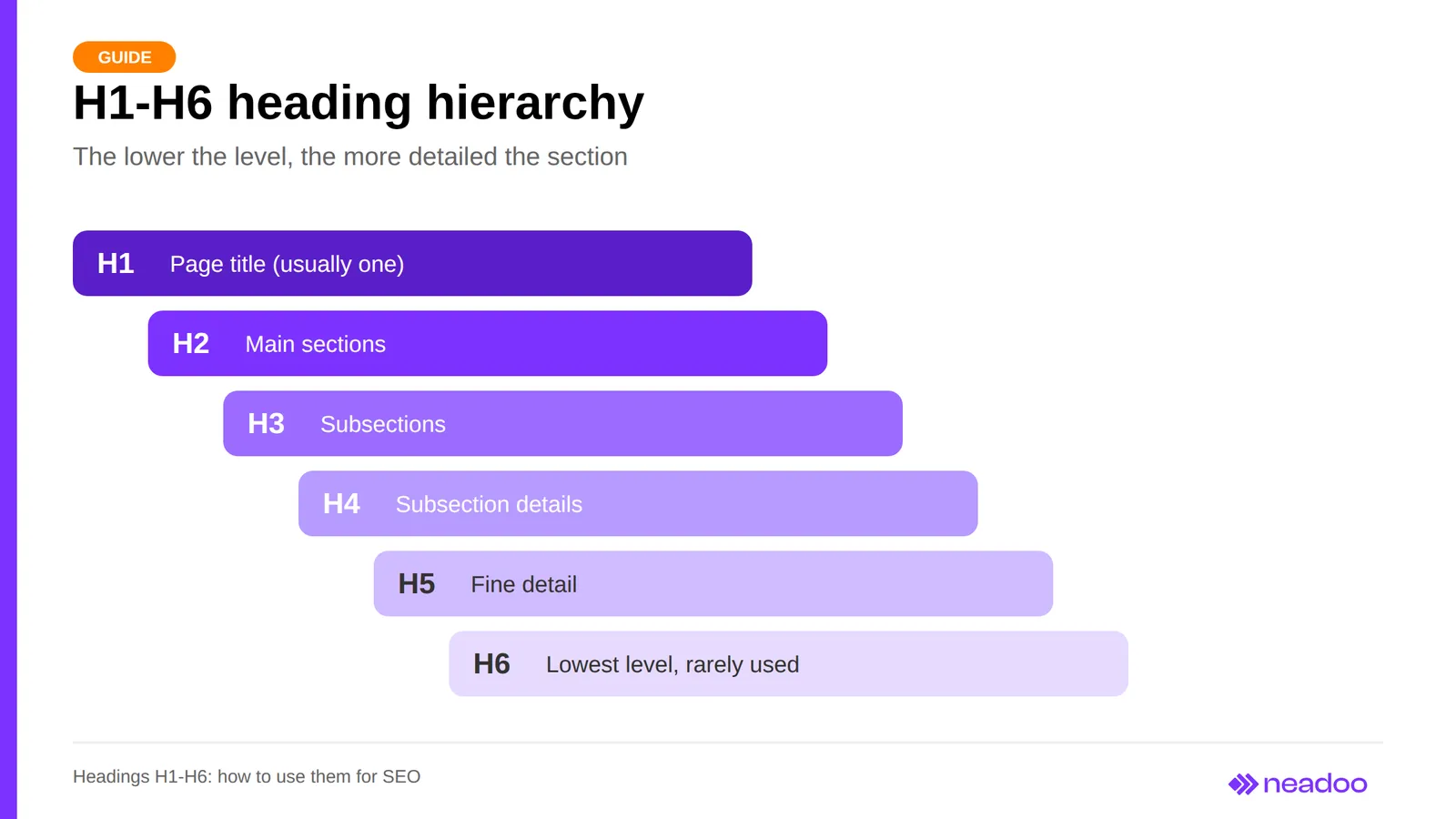
HTML headings are the H1-H6 tags, representing six levels: H1 is the highest, H6 is the lowest, and H7 does not exist in the standard. They are written as a pair of tags - an opening tag (<h1>, <h2>, etc.) and a closing tag (</h1>, </h2>, etc.) - directly in the HTML code. As a result, the text between them becomes a semantically marked heading rather than simple bold text. When someone asks what a heading is, the simplest answer is: it is a short section title that previews what follows in the paragraphs beneath it.
The H1, or page heading, acts as the main heading: it defines the title of an article or subpage and its overall topic. H2-H6 are subordinate levels that develop the main topic and break it down into increasingly specific sections, moving from general to specific. The main structural weight is carried by H1-H3 headings, while H4-H6 are used less frequently, mainly in comprehensive texts and technical documentation. Search engine crawlers interpret headings based on their semantic meaning: they indicate which sections are parent and which are subordinate. HTML headings also break long blocks of text into smaller sections, making it easier for users scanning the page, Google bots analyzing the code, and screen readers used by visually impaired people to find their way around. Without this division, a page turns into a wall of text that is difficult to navigate for both humans and machines.
Understanding this structure is the starting point for further work. Proper use of headings is one of the foundational elements of on-site search engine optimization.
How headings impact SEO: facts and myths
Headings on a website help crawlers understand its topic and structure, but none of them acts as an isolated ranking factor independent of the content. Google describes headings primarily as a navigation aid for users and does not specify an ideal number of headings, while John Mueller has repeatedly emphasized that a page can rank well both without an H1 and with multiple H1s. When a crawler scans a page's code, it treats the heading content as a signal about which sections describe a given topic, helping match the page to search queries in results. H1 and H2 headings usually describe the main topic and key sections, so in practice they carry the most important keywords, but Google has never confirmed their supreme ranking power. H4-H6 headings organize detailed subtopics, and their impact on rankings is marginal. Therefore, the significance of headings in SEO is indirect.
| Claim | Verdict |
|---|---|
| Headings help search engines understand a page's structure and topic | Fact |
| The number and order of headings is a standalone, significant ranking factor | Myth |
| The H1 has a Google-confirmed greatest impact on rankings | Myth |
| A missing H1 makes it impossible to achieve good rankings | Myth |
| Having more than one H1 is a critical ranking issue | Myth |
| Skipping a level (e.g., straight from H2 to H4) always lowers rankings | Myth |
| Headings formatted as questions guarantee a featured snippet or AI answer | Myth |
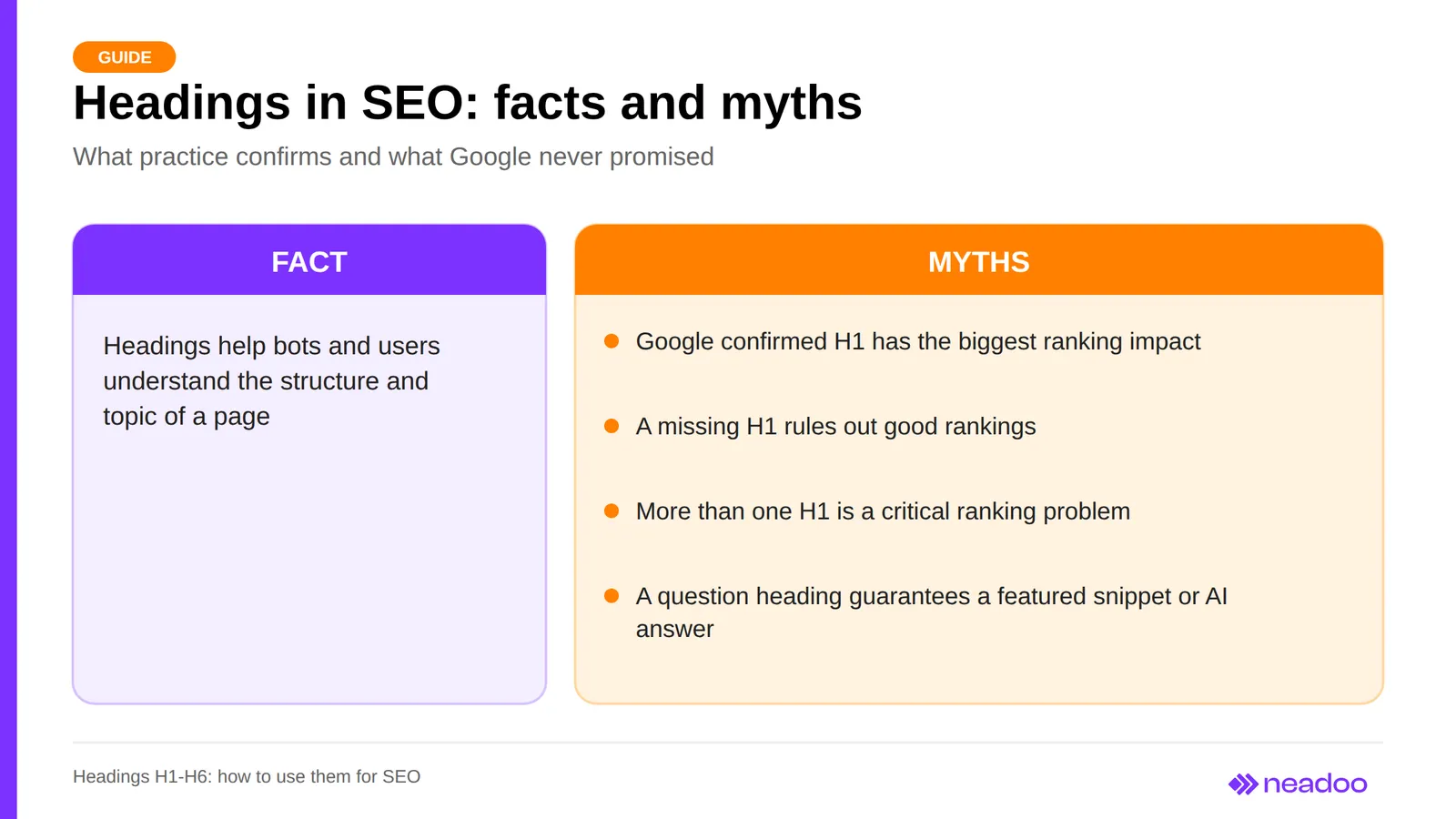
Separating fact from myth is important during a content audit. The heading structure should reflect the thematic logic of the document and facilitate navigation, rather than satisfy requirements that Google does not enforce. The most important thing is that the H1 clearly identifies the main topic, while the H2 and subsequent levels logically develop it.
Heading hierarchy on a page: how to build the structure step by step
The pyramid principle and not skipping levels
The fundamental rule of building a heading structure is: do not skip levels without good reason, and treat lower-level headings as expansions of higher ones. The hierarchy resembles a pyramid, with the H1 at the top, H2 and H3 as subordinate headings, and H4-H6 detailing the specifics. Headings arranged in proper hierarchy divide content into logical sections and create a clear structure that guides the user effortlessly. Each lower level is subordinate to the higher one, much like chapters and subchapters in a document: an H3 develops a thread introduced by an H2, and an H2 develops a part of the topic from the H1. Jumping directly from an H2 to an H4 while skipping an H3 is a common nesting mistake. Google does not penalize this in rankings, but the HTML specification and accessibility guidelines recommend avoiding skipped levels, as the jump impairs screen readers, worsens code readability, and disrupts the heading tree in audit tools. A practical rule of thumb: the next heading can be at the same level, one step lower, or return to a higher level in a new section.
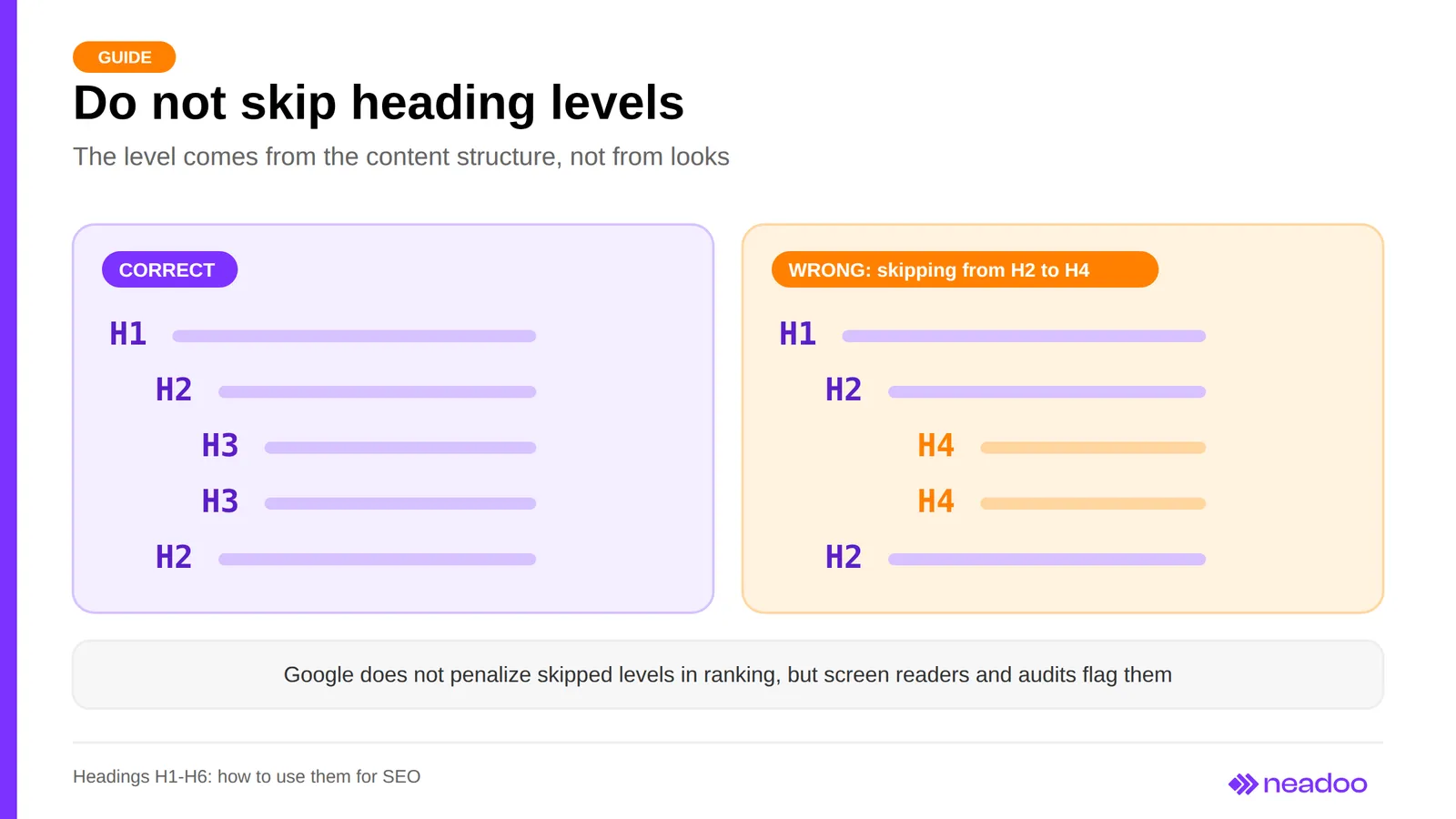
Sample heading tree for a single article
A heading tree for an article on SEO headings demonstrates proper hierarchy in practice:
H1  How to Use Headings on a Website According to SEO Best Practices
  H2  What Are H1-H6 Tags
    H3  Heading Tag Structure in HTML
    H3  Differences Between H1 and H6 Levels
  H2  Heading Hierarchy Step by Step
    H3  The Pyramid Principle and Not Skipping Levels
    H3  Sample Heading Tree
      H4  Example for a Blog Post
      H4  Example for a Product Page
  H2  Most Common Mistakes in Heading Structure
Each H3 is subordinate to a specific H2, not to the entire article. An H4 appears only where a given H3 requires further division into specific cases, rather than "just in case" in every section.
Let's check your website's potential
Share your website and email - we'll get back to you with a real analysis, no strings attached.
H1 Heading: How Many Can There Be and How to Write One
The recommendation to use a single H1 heading per page, including the homepage, is an editorial and accessibility convention rather than a Google requirement. The HTML specification does not prohibit multiple H1s as long as they are not nested, and missing an H1 does not block ranking either. However, a single clear H1 remains best practice: it clearly communicates the document's topic to users, search bots, and screen readers. Having more than one H1 is often an organizational issue rather than a ranking one. A typical case is a CMS template that automatically generates extra H1s in sidebar widgets or section headings alongside the page's main title, which blurs the line between the entire page title and the titles of its parts. Conversely, lacking an H1 deprives the other levels of a frame of reference, so it is worth using one on every page (article, category, product page).
A good H1 heading is short, visible to users, matches the page topic and content, contains the primary keyword, and satisfies search intent. A heading suggesting a different topic than the actual content increases the bounce rate, while an overly verbose one resembles a lead paragraph and loses its function as a title. A single primary keyword chosen through query analysis is enough, rather than a list of keywords separated by commas. On a product page, the H1 heading is usually just the product name; on a category page, it is the category name from the CMS (it is best to allow manual editing); and across a large number of pages, it is most convenient to generate it from a template, for example, "{Category name} - online store".
The H1 heading must be visible to both Googlebot and users. Hiding it using tiny font sizes, text color matching the background, or the display: none rule is a classic Black Hat SEO technique that brings no real benefits and, if detected, risks losing algorithmic trust for the domain.
H1 vs. Meta Title: Identical or Different
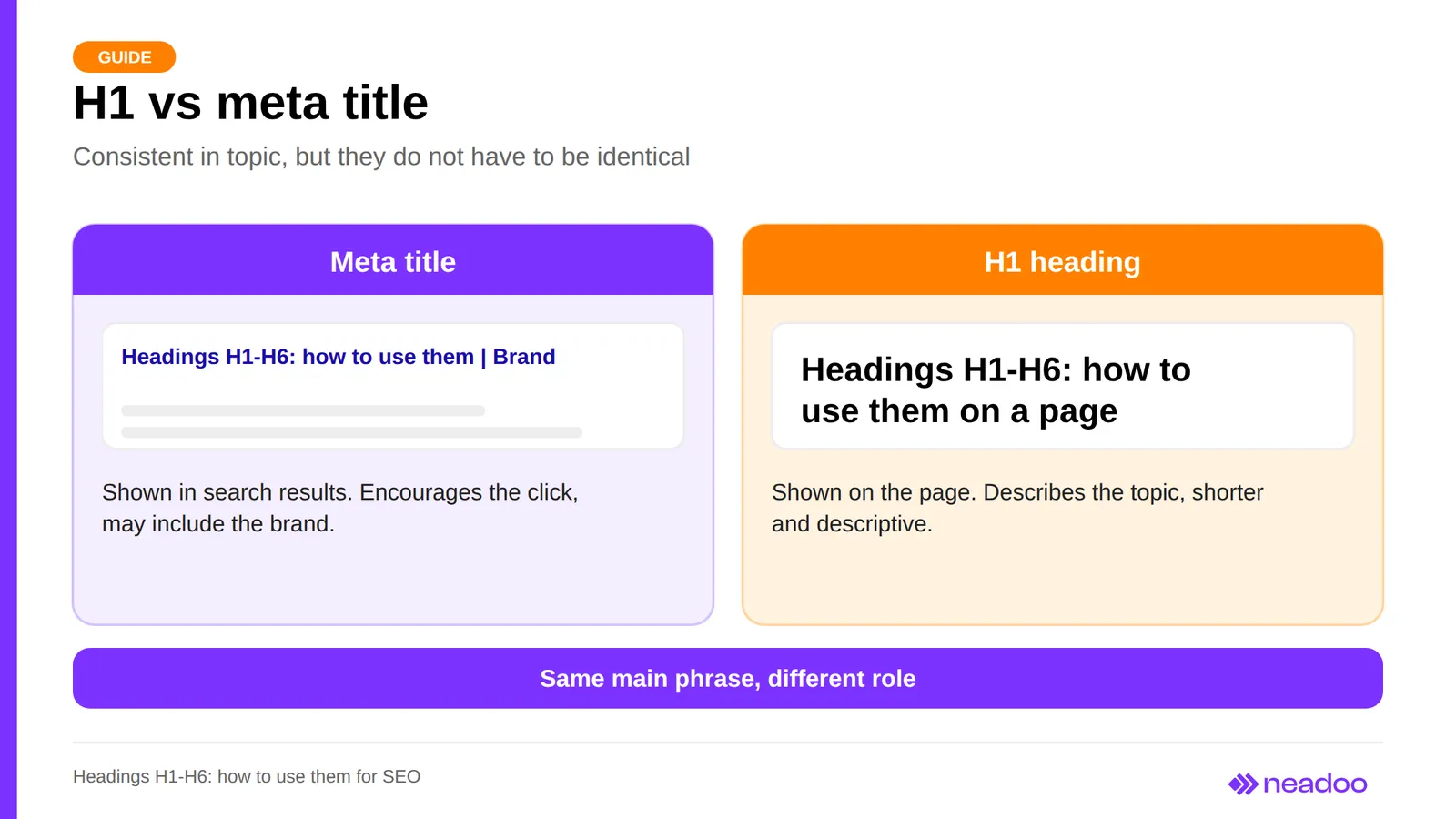
The title meta tag and the H1 heading do not need to be identical; it is enough that they are thematically consistent and contain the same primary keyword. Sources disagree on this point: some experts recommend almost identical phrasing for both elements to reinforce keyword weight, while others advise against duplication because the two serve different functions. In practice, the title, located in the <head> section, appears in search results as the clickable page title (Google may rewrite it) and can be longer, more marketing-oriented, and include the brand name. The H1 is seen only by someone who has landed on the page, so as the page title and article title, it should be shorter and descriptive, aimed at someone already reading the content.
Distributing Keywords Across Heading Levels
H1-H6 headings organize content by keyword importance: the primary phrase goes into the H1, related phrases into H2 and H3 headings, and synonyms and long-tail variations into H4-H6, always sounding natural. Placing keywords in headings must not look like stuffing. Keywords in headings signal to both readers and algorithms which section carries key value, but this reflects the logic of content construction, not a formal ranking mechanism.
| Level | Keyword Type | Example |
|---|---|---|
| H1 | Primary keyword | Coffee makers: Ranking and model comparison |
| H2 | Related keyword | How to choose a coffee maker for the office |
| H2 | Related keyword | Espresso machine vs. drip coffee maker: Differences |
| H3 | Section subtitle | Pump pressure vs. espresso quality |
| H4 | Long tail | Quietest coffee maker for a small apartment |
| H5-H6 | Synonyms, variations | Coffee machine, manual espresso machine |
The H1 contains the most important keyword in its most general form, while H2s expand it into key subtopics. H3-H6 headings dive into details and have a limited impact because they structure content within sections, for example, breaking down a product feature list into bullet points. Thanks to heading hierarchy, each keyword has its place and does not compete with the others.
Question-Based Headings, Featured Snippets, and AI Answers
A question-based heading with a concise answer right below it increases the chances of earning a featured snippet and being cited by AI-driven search engines, as the question-and-answer format makes it easier to extract a ready-made snippet. However, the mere presence of a question in a heading does not guarantee a featured snippet or an AI response. Google even emphasizes in its 2026 guidance that the same SEO principles apply to generative features, without the need for special markup. The question should be phrased the way a user actually asks it, and the answer should appear in the first sentence or two under the heading, as that captures the reader's attention. Beneath a heading like "Can an H1 appear more than once on a page?", the answer should come immediately ("Yes, Google allows multiple H1 elements and does not treat it as a ranking error"), followed by the explanation.
FAQPage structured data can mark up questions and answers for machines, but Google displays FAQ rich results primarily for government and healthcare websites, and HowTo results have been deprecated, so they cannot replace a well-crafted in-content answer. The question format falls short where it does not naturally stem from the content or when it describes a feature list or procedural steps: "Technical specifications of Model X" is more natural than "What are the specifications of Model X?". A good structure mixes formats depending on the function of the section.
Headings vs. CSS, Accessibility, and UX
The heading level depends solely on document structure, while its appearance (size, font, color, capitalization) is styled via CSS. You do not choose an H2 or H3 because it needs to be larger or smaller, but because it defines where content sits within the outline. If a subheading should look more understated, you give it a class (<h3>) and define a smaller font-size, while uppercase letters are achieved with text-transform: uppercase. Blending semantics with styling leads to nesting errors and makes code analysis harder for crawler bots, screen readers, and anyone maintaining the code later.
A logical heading structure is also essential for accessibility. A blind person rarely reads a webpage linearly: a screen reader generates a heading list and allows them to jump between sections using keyboard shortcuts. WCAG guidelines require that relationships between content elements can be programmatically determined (Criterion 1.3.1), meaning a heading must be an actual <h1>-<h6> tag rather than a bold paragraph, and that headings clearly describe the section topic (Criterion 2.4.6). Skipping from H2 to H4 suggests nesting that does not exist and confuses anyone navigating via a heading list.
Website headings reduce bounce rate only indirectly: not as a ranking factor, but through a better user experience. A user scans section subheadings to assess whether they will find answers to their questions, so the more precisely a heading describes the paragraphs beneath it, the quicker they decide to keep reading. Vague titles like "More information" offer no help and can negatively impact UX. Image SEO is driven by surrounding text, alt text, and file names, with an adjacent heading supporting them only indirectly.
Headings in online stores and CMS templates
Automatically generating the H1 in a CMS template (product name on the product page, category name on the category page) is safer than entering it manually because online stores generate thousands of pages from a single template, and an error in the heading structure replicates automatically. WooCommerce, PrestaShop, Shopify, and Magento map the product or category name to H1 by default, which eliminates empty headings, but it creates the issue of duplicate H1s across variants of the same product.
Faceted navigation and paginated pages have the weakest headings: templates either do not create a separate H1 for them or copy the parent category heading, repeating the same H1 across all pages in the list. Repeating an H1 is not a penalty in itself, but it makes it harder to distinguish pages and match them with user intent in search results. When choosing a theme, check whether the editor lets you override the default field mapping for H1, as some templates rigidly tie the heading to the database record's technical title.
Most common heading errors and their consequences
The most common errors on your site are missing H1 tags, multiple H1 tags within a single document, skipping hierarchy levels (for example, jumping from H2 to H4), and selecting levels based on appearance rather than meaning. None of these are formally penalized by Google, but each dilutes the document outline and makes navigation harder for screen reader users.
The second group involves content-related mistakes: generic or promotional headings that fail to describe the paragraphs beneath them, an incorrect sequence of sections relative to the topic's logic, and non-standard levels like H7, which browsers may ignore. Another mistake is treating question-based headings as a guaranteed ticket to a featured snippet: a question improves alignment with search intent, but without an accurate, thorough answer in the content, it changes nothing. Best practices are straightforward: a heading should describe the content beneath it, not advertise it.
How to check and audit heading structure
Auditing headings on your site requires tools that extract the H1-H6 hierarchy from the code without manually browsing the HTML. Lighthouse in Chrome DevTools highlights issues such as improper heading order in its accessibility section, while Screaming Frog SEO Spider crawls the entire site and exports headings for every URL, catching duplicate H1s across category pages, product pages, or filtered variants. Browser extensions such as HeadingsMap display the outline as a nested list, making a jump from H2 to H4 instantly visible as a gap. In the source code, search for the string <h to verify that headings are not being faked with a bold <div>.
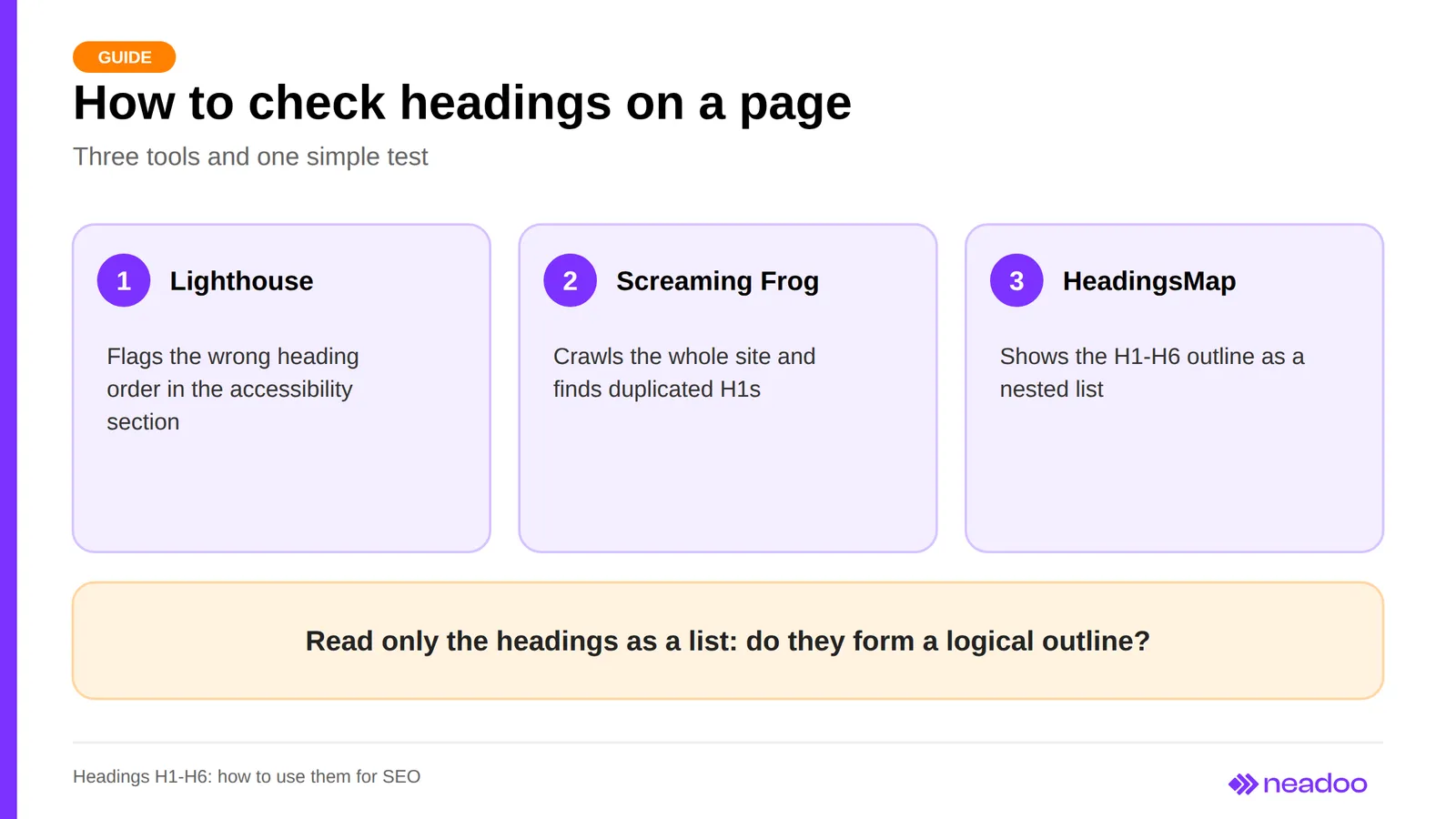
The second test is simpler: extract just the headings and read them as a standalone list. If the sequence of H1, H2, and H3 elements reads top-to-bottom as a logical outline - from the broad topic down to successive subtopics - the hierarchy is doing its job. A list that sounds like a random collection of phrases indicates a structural problem, even when no tag violates HTML rules. Tools detect technical errors, while reading through the list itself evaluates the substantive quality of your outline.
FAQ
How many H1 headings should be on a page?
One H1 per page, including the homepage, is recommended, but this is a convention rather than a Google requirement: John Mueller has confirmed that a page can rank well both without an H1 and with multiple H1s.
Does an H7 heading exist?
No. HTML only supports H1-H6 tags; H7 and lower levels are not supported.
Does the H1 have to match the meta title tag?
It does not have to, but both should accurately describe the page topic and include the primary keyword. The H1 serves as the "header" of the on-page content, while the title is a separate element displayed in search results.
Can you change a heading level just to get a larger font?
No. The heading level should reflect the content structure, while font size should be styled using CSS.
Can you hide the H1 on a page?
It is not recommended. The H1 should be visible to both users and crawlers, and hiding it using tiny font sizes, background colors, or the display: none rule can be interpreted as manipulation.